Jun Murakami Synth81Z v1.0.2 Incl Patched and Keygen-R2R
WiN | 9.53 MB
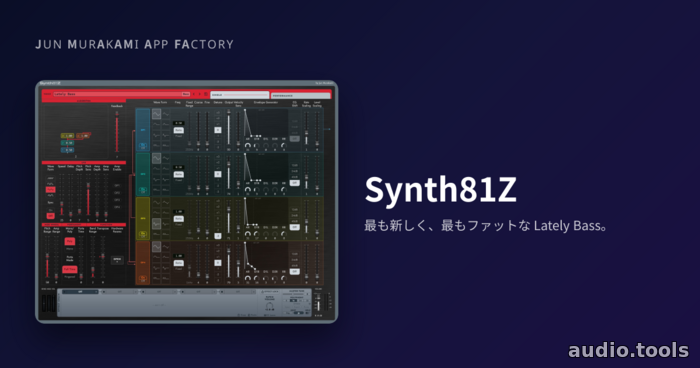
The newest, and the fattest, Lately Bass. A compact four-operator FM synthesizer.
Released in 1987, the Yamaha TX81Z is a four-operator FM tone generator in a 1U rack. Conceived as an affordable way to bring the FM synthesis pioneered by the six-operator DX7 to more musicians, this small unit nevertheless holds features that even its bigger siblings lacked: where earlier FM synths offered only sine waves, each of the TX81Z’s operators can choose from eight waveforms. Combined with the character of its distinctive analog circuitry, this gives it an appealing sound quite unlike the DX7.
Above all, the preset “Lately Bass” is the sound that wrote the TX81Z into music history. With its distorted harmonics, razor-sharp attack and tenacious low end, it anchored countless hits from the late 1980s through the 1990s, above all in dance music.
It was never an easy machine to program from its front panel, but its affordable price and iconic sounds earned it a place in the studio racks of countless musicians, including, back in the day, the developer of this plugin.
The latest TX81Z sound, refined by hardware measurement
The TX81Z’s sound is concentrated in a single FM chip, the YM2414 (better known as the OPZ), and its output stage. Being digital synths, Yamaha’s FM chips have been documented and emulated many times before. But once I focused on the TX81Z as a single instrument, it became clear that those implementations fell far short. And so, as with Synth-80, the development of Synth81Z began with exhaustive measurement of the hardware.
In the end, it matches the hardware in detail: the phase resolution of the operators and the rounding of the waveform tables, the fine detail of each of the eight waveforms, output levels that change with the algorithm, the timing of every envelope step, the response to the LFO, velocity and controllers, and the frequency response from the DAC through the output stage. Everything, “Lately Bass” included, was then pushed to the limit by ear against recordings of the real unit.
Up to 32 voices of polyphony
Choose 8, 16, 24 or 32 voices. Eight matches the hardware; the higher settings are the software equivalent of stacking several chips.
Eight-part Performance mode
Hardware-compatible layers, splits and multitimbral setups, plus a mode with continuous pan and an independent LFO for every part, making it comfortable to use as software.
Five-slot effects rack
Twelve high-quality effects inherited from Synth-80: four choruses (Synth, Studio, Pitch and Digital), Delay, Phaser, Flanger, EQ, Compressor, Distortion, Reverb and Arpeggiator.
Editor and librarian
Connect a real TX81Z over MIDI and your edits in the plugin are mirrored to the hardware. SysEx send/receive for voices, Performances and tables, .syx/.mid import and a bank builder let you keep using your hardware voice library.
MIDI Learn and DAW automation are supported as well. None of these additions alters the hardware sound: set the polyphony back to 8 and you have the behaviour of a single chip, exactly like the original.
Русские пользователи — используйте ВПН для скачивания!
Наши ссылки не работают для России и возможно каких-то других стран!
Russian users — use VPN to download!
Our links do not work for Russia and possibly some other countries!