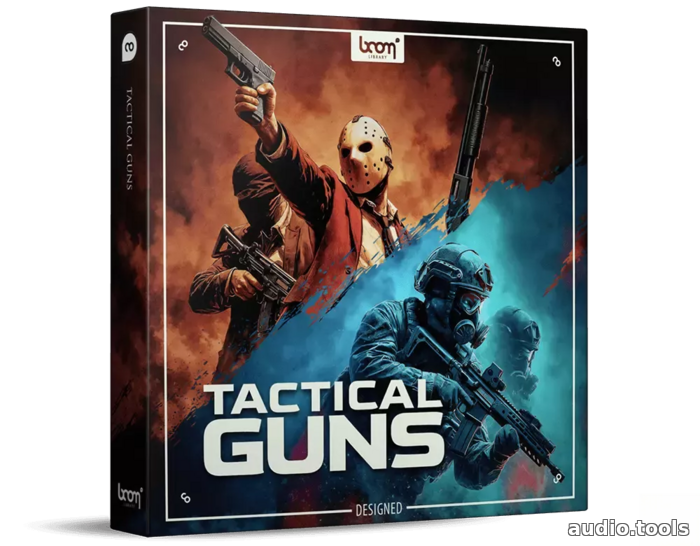
Machine Gun, Pistol, Rifle and Shotgun Sounds From Real Service Weapons
When a script calls for a detective’s sidearm, a squad’s service rifle, or the gun a criminal actually carries, most libraries hand you gunfire sorted by caliber, with no sense of who would use it or why. TACTICAL GUNS starts from a different premise: every one of its 25 weapons is carried by police, issued to armies, or used by criminals. One purchase covers a police procedural, a military scene, and a criminal underworld sequence, each one built from the actual weapons those characters would carry, with matched handling recorded for almost every one.
Carried. Issued. Stolen.
Every weapon in TACTICAL GUNS is one carried by police, issued to armies, or used by criminals. That’s the reason each weapon made the list, not caliber or category alone.
Matched Handling, Weapon by Weapon
Almost every weapon ships with its own recorded handling: grab, mag change, safety, reload. That’s the sound before the shot, the detail that makes a character read as competent, or desperate, before they ever fire.
Twenty-Eight Channels, Multiple Distances
Every shot is captured across up to 28 channels, from point-blank out to 100 meters, delivered across eight named perspectives. Cut between an interior take and a rooftop vantage point using material actually recorded for that perspective.
Built for Any Production Pipeline
UCS-tagged metadata keeps every weapon and fire mode addressable across DAWs, video editors, and game engines alike. For tactical and law-enforcement titles specifically, individual shots stay triggerable for event-driven, physics-based systems.
Close, Distant, Heavy, and Mechanical Mixes
The Designed layer contains 850+ pre-assembled sequences per weapon category (assault rifles, machine guns, pistols, rifles, shotguns, and submachine guns), each mixed as Close, Distant, Heavy, and Mechanical variants across single shots, bursts, and full auto.
Built From the Same Construction Kit Elements
Every Designed sequence is built from the same shot and handling recordings available in the Construction Kit, not separately produced, so the mixes reflect the same weapons and the same recorded detail throughout the library.
Why These Weapons
TACTICAL GUNS records 25 weapons chosen for being carried by police, issued to armies, or used by criminals. Each one’s real-world use was checked against public sources during research, part of the same premise that shaped which 25 weapons made the library, not caliber alone. Where a weapon’s service record couldn’t be verified, it’s described by sound and specification only, not by a claim the library can’t support.
Assault Rifles
AK-47
FN FAL
HK G36
IMI Galil
M16
SIG MCX
Steyr AUG
Tavor TAR-21
Sub Machine Guns & Shotguns
RAK PM63
UZI
VZ 61 Skorpion
Kel-Tec KSG
Remington 870
Saiga-12
Machine Guns & Rifles
M60
MG3
PKM
AWM
M14
M82A1
SVD Dragunov
Pistols & Revolvers
Arsenal Firearms Strike One
Glock 17
IMI Desert Eagle
Smith & Wesson Model 29
The Shot Sessions
The shot sessions captured every take across up to 28 channels simultaneously, each perspective tied to its own distance from the shooter. DPA 4062 mics on the collar and wrist (0m each) captured on-body detail. The AB perspective was recorded at three distances with three different pairs, Sennheiser MKH 416 at 1m, Audix D6 between shooter and muzzle at 2m, and DPA 4007 at 3m. The MS perspective was recorded at two distances, Sanken CMS50 at 5m and Sennheiser MKH8050/MKH30 at 15m, and the XY perspective at two more, Sennheiser MKH8050 at 5m and Sony PCM out at 100m. Schoeps ORTF3D (20m) and a Sennheiser AMBEO VR mic (50m) added 3D capture for immersive formats. Each shot is delivered across eight named perspectives: Collar, Wrist, AB, MS, XY, Ambisonic (AmbiX), and ORTF3D High/Low. A DPA 4062 pair at shoulder height was part of the recording rig too, but isn’t delivered as its own perspective file.
The Handling Sessions
A separate set of sessions covered handling, the mechanical sounds around the shot rather than the shot itself. Grabbing the weapon, working the safety, loading and unloading the magazine, reloading fast and slow. This was recorded per weapon wherever practical. Two exceptions use disclosed substitute handling instead of a dedicated session: the Kel-Tec KSG uses SPAS-15 handling, and the Tavor TAR-21 uses AKS-74U handling.
The Designed Layer
The Designed layer was built last, mixing the raw shot and handling material into ready sequences by category and intensity: Close, Distant, Heavy, and Mechanical. The finished library covers both the component-level workflow and the fast, pre-assembled one.
What’s so special about this library?
The Core Question
Most gunfire libraries sort their content by caliber or weapon type and stop there. A 9mm shot is a 9mm shot, regardless of whether it belongs in a police procedural, a war film, or a heist. TACTICAL GUNS starts from a different question: who actually carries this weapon, and what does that mean for the scene it’s dropped into? A Glock 17 in a detective’s hand and an AK-47 slung over a soldier’s shoulder aren’t interchangeable gunfire, they’re different characters, and that real-world context, not caliber alone, is what shaped which weapons are in this library.
Three Worlds, One Library
The campaign’s own structure makes the point concrete: every weapon in the library belongs to one of three worlds: carried by police, issued to armies, or used by criminals. The highlights below cover a few from each; the full arsenal breakdown follows them.
Carried by Police
The Glock 17 has been standard issue for the Austrian military since 1982 and is carried widely across police departments in the US and Europe. The Remington 870 was long the standard patrol shotgun in American law enforcement: heritage service, not current-day standard, as many departments have since shifted to patrol rifles. These are the street-level weapons: a stakeout, a raid, a traffic stop that goes wrong.
Issued to Armies
The AK-47 is, historically, the most widely used rifle in the world, in heavy and ongoing service across Russian forces and militaries throughout Africa and Eastern Europe. The PKM holds the same territory in a squad support role, confirmed across Eastern Europe, Africa, and the Middle East. The AWM was adopted by the British Armed Forces as its long-range sniper rifle, fielded by the 16 Air Assault Brigade, the Royal Marines, and the RAF Regiment. The set is rounded out by service rifles including the FN FAL, SIG MCX, and M14. The HK G36 has been standard issue for the German Bundeswehr since 1997; the IMI Galil served Israeli infantry for decades and was adopted as the standard army rifle of Colombia and South Africa (as the Vektor R4); the M16 has been the standard rifle of the US Armed Forces since 1964 and remains in service with dozens of allied militaries; the Steyr AUG is the current standard rifle of Austria, Ireland, Luxembourg, and Tunisia; and the Tavor TAR-21 became the standard infantry rifle of the Israel Defense Forces in 2018.
Used by Criminals
The VZ 61 Skorpion is the strongest weapon in this library for documented criminal use: confirmed use by the IRA, the Italian Red Brigades, the Red Army Faction, and, more recently, organised crime gangs in Sweden and the UK. The AK-47 belongs here too, as one of the most trafficked rifles in the world. The Uzi carries a “criminal gun” reputation that owes more to pop culture and desirability than to a documented crime record; it’s included here on that understanding, not overstated.
The Full Arsenal
Twenty-two of the library’s 25 weapons carry a documented real-world claim strong enough to place them in one or more of the three worlds; the rest are included for their sound and technical profile, without an unsupported claim attached.
Distance and Perspective
The distance and perspective range solves a separate, practical problem. A scene rarely stays at one distance or one camera position, and re-recording or pitch-shifting a single perspective to fake another is audible. Capturing every shot across up to 28 channels, from point-blank to 100 meters, means the cut from an interior to a rooftop vantage point uses real material recorded for that exact perspective, not an approximation of it.
The Handling Layer
The handling layer addresses what happens before and after the shot, which is often what actually sells a scene. A character checking the safety, working a slide, or reloading under pressure tells the audience more about their state of mind than the gunfire itself. Matched per weapon, that handling turns a static prop sound into a performing one.
Use cases:
- Police procedural and crime drama scenes needing service-accurate sidearms and patrol shotguns
- War and military film and TV needing real service rifles and squad support weapons
- Organised crime, heist, and trafficking sequences needing weapons with a real criminal-use record
- Game audio teams building tactical or law-enforcement combat systems that need real spread across sidearms and shotguns, not another pile of rifles
- Editors cutting between interior and exterior or near and far camera positions within the same gunfight
Tips:
- Match the weapon to the scene’s real-world logic first (who would actually carry this), then to the sound. Carried, issued, or used is the fastest way to narrow 25 weapons down to the right one
- Use the Collar or Wrist perspective for a first-person or close interior cut, then switch to the AB or ORTF3D perspective at distance for the same event without an audible seam
- Layer the handling recordings ahead of the shot to build tension before a scene turns; a mag check or a safety click reads as character, not just mechanics
- Start from a Designed mix for a fast edit, then drop down to the Construction Kit shot and handling elements when a scene needs a perspective the mix doesn’t cover
COMPATIBLE SOFTWARE
This BOOM Library of creature sounds comes as WAV files, meaning you can import and work with them in any software that can handle this file type.
RICH METADATA EMBEDDED
To provide you with the fastest and easiest workflow possible, all files contain extensive metadata like file description & keywords to quickly find the sounds you’re looking for. Metadata can be read and processed by audio management tools.
Русские пользователи - используйте ВПН для скачивания!
Наши ссылки не работают для России и возможно каких-то других стран!
Russian users - use VPN to download!
Our links do not work for Russia and possibly some other countries!